6 Types of Aquarium Algae: How to Identify and Treat Them
Diatoms, green spot, hair, black beard, blue-green, and green water: identify the six common aquarium algae by color, shape, and location, plus fixes.
"I've got algae" can mean a brown film, green dots, or black fuzz, and each one has a different cause and a different fix. The good news: there are six common types of aquarium algae, and you can tell them apart by color, shape, and where they grow, even as a beginner. Better still, a few core fixes help with all of them. This guide lays out the six types in a quick-reference table and tells you what to do once you've identified yours.
Quick reference: the six algae types
| Type | Appearance | Where it grows | Main cause |
|---|---|---|---|
| Brown algae (diatoms) | Brown to tan film; wipes off easily | Glass, leaves, substrate | Unstable new tank |
| Green spot algae | Hard green dots; resists a sponge | Glass, slow-growing leaves | Too much light |
| Hair algae | Fine green threads; can be twirled off | Plants, driftwood | Excess nutrients |
| Black beard algae | Short black to dark gray tufts | Leaf edges, driftwood, pipes | Excess phosphate plus strong flow |
| Blue-green algae (cyanobacteria) | Slimy blue-green sheet; foul smell | Substrate, along the glass | Dead spots plus excess nutrients (a bacterium, not an alga) |
| Green water | The water itself turns green | Suspended in the water | Free-floating algae |
To identify yours, check color first (brown, green, black, blue-green), then form (film, dots, threads, tufts), then location.
Each type in a little more detail
Brown algae (diatoms)
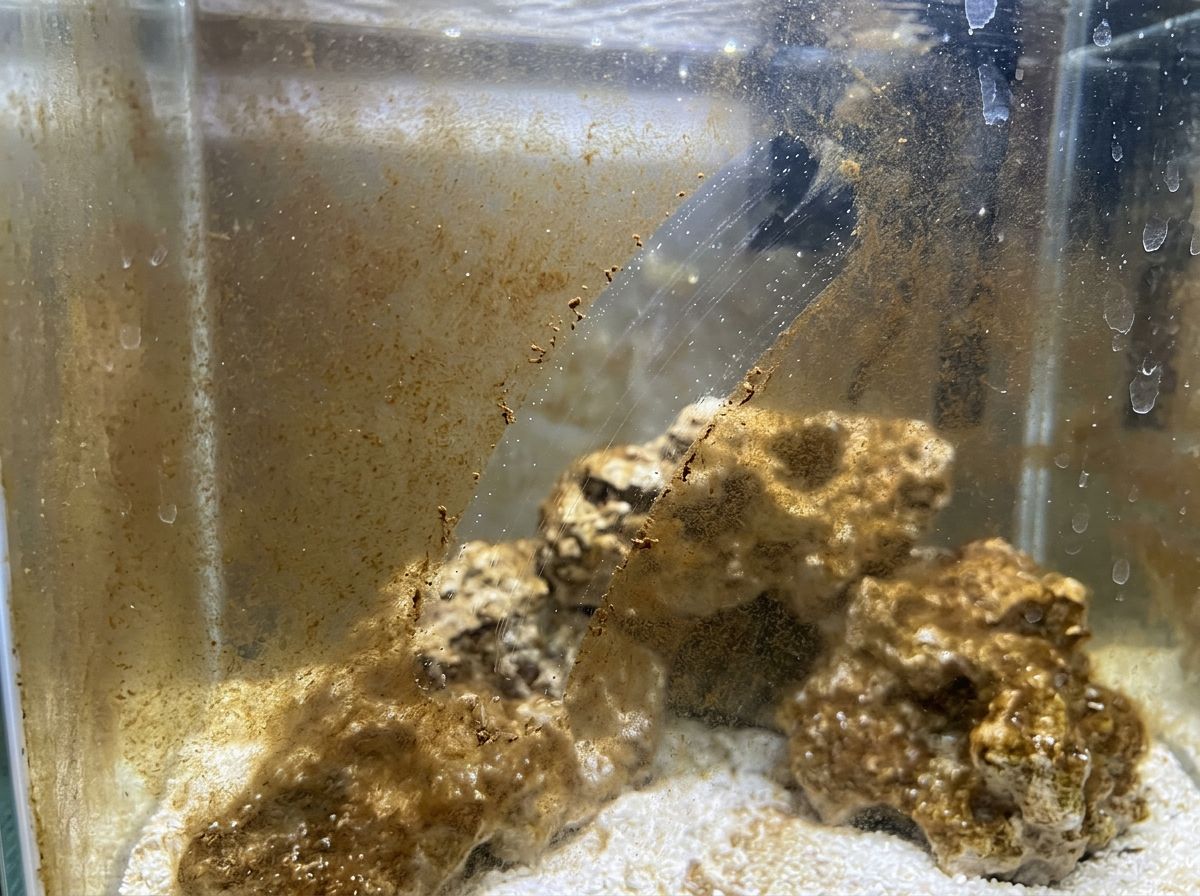
The brown film that shows up in almost every tank during its first few weeks. It wipes off with a fingertip. As the tank stabilizes past the 4-6 weeks it takes to cycle, diatoms usually fade on their own.
Green spot algae
Small, hard green dots on the glass and on slow-growing leaves such as Anubias. A sponge won't shift them; you need a scraper. The main driver is too much light, typically a photoperiod that runs too long.
Hair algae
Fine green threads trailing from plants and driftwood. Long strands can be twirled around a finger or toothbrush. It thrives on excess nutrients, which usually trace back to skipped water changes, overfeeding, or overdosing fertilizer.
Black beard algae
Short black tufts on leaf edges, driftwood, and filter outlets, anywhere the flow is strong. It's associated with excess phosphate combined with strong current, and it's the hardest of the six to remove. We cover it in depth in a separate article.
Blue-green algae (cyanobacteria)
A slimy blue-green sheet that spreads over the substrate and along the glass, with a distinctive unpleasant smell. Don't go by color alone; check for the slimy sheet-like texture and the smell as well. It's actually a bacterium, not an alga, and it favors spots with no water movement combined with excess nutrients. Siphon it out when you see it and adjust your layout or filter outlet so flow reaches the dead zone.
Green water
Rather than growing on surfaces, the water itself turns green. It's a bloom of free-floating algae, triggered by plenty of light and nutrients.
The fixes that work for every type
The details differ, but every algae problem boils down to too much nutrition, too much light, or both. The shared strategy is to bring those two back in line.
1. Cut excess nutrients
- Change 10-30% of the water once a week. Nitrate above 40-50 mg/L is a clear signal (target 0-25 mg/L, ideally under 10)
- Feed once or twice a day, only what's eaten within 2-3 minutes, and remove leftovers
- If you dose plant fertilizer, review the amount. Overfertilizing leads straight to algae, and it pays to cut back right after trimming
2. Limit the photoperiod
- Run lights 6-10 hours a day, with 8 hours as the standard. If algae is a problem, keep it within 8-10 hours. Beyond 10 hours, algae growth picks up noticeably
- Turn lights on and off at the same time every day. A timer makes this effortless
3. Remove it by hand
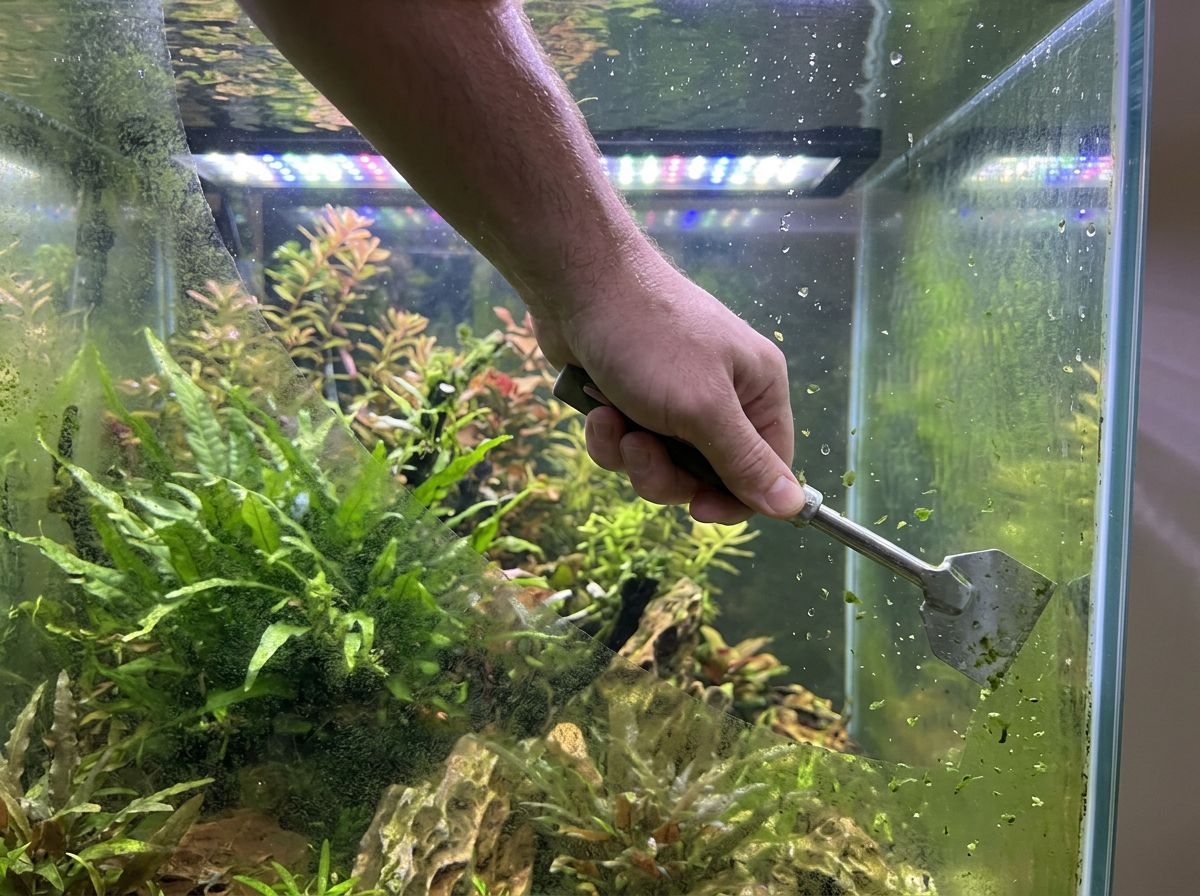
- Make a weekly glass scrape part of your routine
- Siphon out dislodged algae during your water change
- For leaves that are heavily coated, cutting them off is often faster than scrubbing
Choosing algae-eating livestock
Algae eaters are a great finishing touch but not a cure-all, and each species has its specialty.
- Amano shrimp: the go-to for hair algae and other soft types
- Otocinclus: film algae on glass and leaf surfaces
- Siamese algae eater: one of the few species known to eat black beard algae
- Nerite snails: glass and rock surfaces
Adding animals adds load, so confirm the cycle is complete (ammonia 0, nitrite 0) and introduce them a few at a time.
The most important habit in algae control is to change one thing at a time so you can tell what worked. Note the day you shortened the photoperiod, cut feeding, or changed water, and take one photo a week. The Aquarium app pairs a photo timeline with water test results, so if you track it in the app you can look back a month later and see exactly which change made the difference.
FAQ
Should I tear down and restart the tank when algae appears?
Almost never. Algae recedes once you correct the underlying cause (nutrients, light). A restart also resets your nitrogen cycle, dropping you back into the unstable phase where diatoms and cloudy water are most likely.
Does algae control differ between planted and unplanted tanks?
The core fixes (water changes, feeding, lighting) are the same. Planted tanks add fertilizer and CO2 to the picture, so check that you're not overdosing. Healthy, fast-growing plants consume nutrients, which makes keeping your plants thriving part of algae control.
Can I have an algae-free tank?
Zero algae is unrealistic, but "barely noticeable" is very achievable. Weekly water changes and cleaning, a fixed photoperiod, and modest feeding are the surest route.
Summary
- The six common aquarium algae are diatoms, green spot, hair, black beard, blue-green, and green water. Identify by color, shape, and location
- Root causes come down to excess nutrients or excess light. Shared fixes: weekly 10-30% water changes, feeding review, lights within 8-10 hours
- Algae eaters each have a specialty. Add them after the cycle is complete, a few at a time
- Change one variable at a time and track the result
Algae is your tank's way of telling you the balance is off. Once you can name the type and guess the cause, it becomes a manageable part of fishkeeping rather than a crisis.