Betta Fish Care Basics: Tank Size, Temperature, and Why They Live Alone
Bettas survive in a jar but thrive in 10 liters or more, heated to 25-28°C, under a lid, and alone. Tank size, feeding, water changes and acclimation.
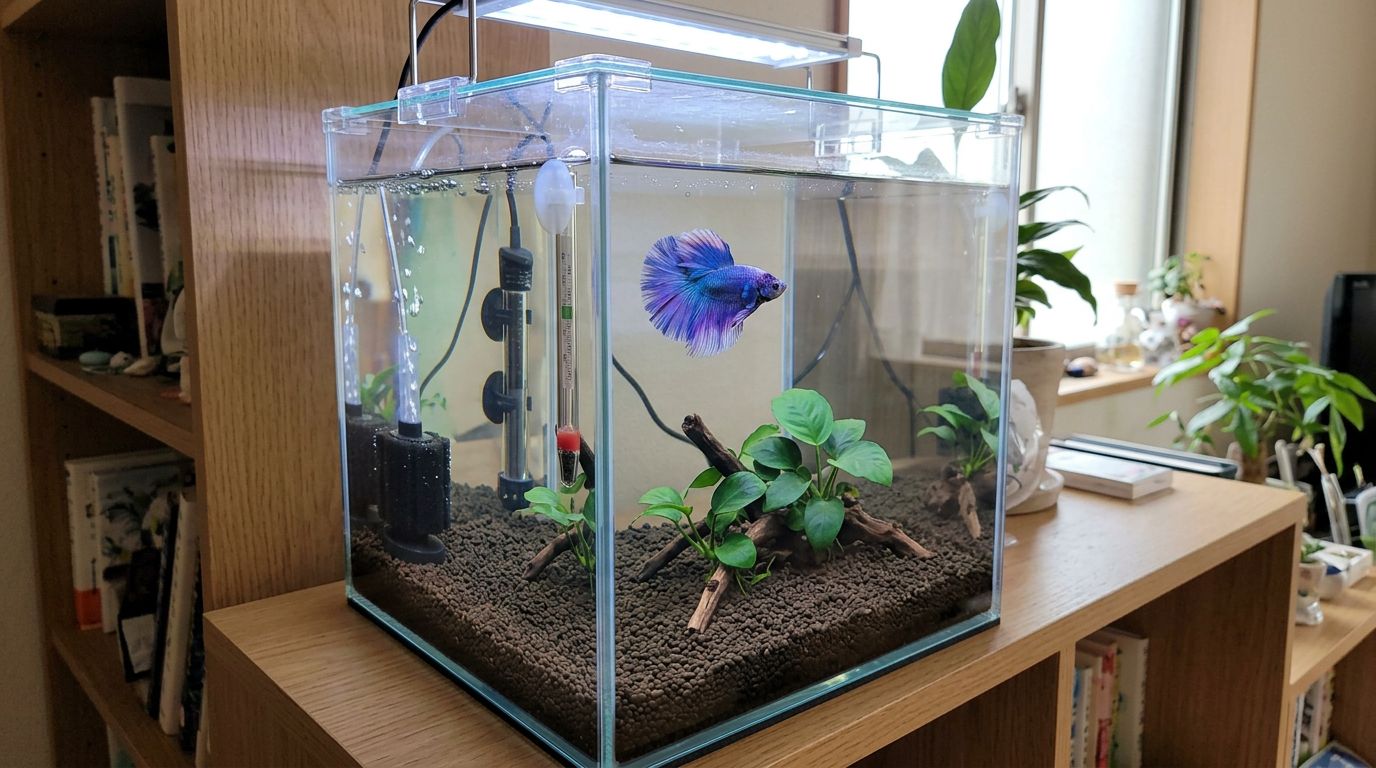
"Bettas can live in a little jar, right?" Seeing them sold in cups, it's an easy assumption. Bettas do have a special organ that lets them breathe air at the surface, so they handle low oxygen well. But "can survive" and "lives a long, healthy life" are different things. In short, the basics for a beginner are 10 liters or more of water, a heater holding 25-28°C, a lid, and keeping them alone. This article explains why, and covers feeding, water changes, and bringing a new betta home.
10 liters minimum, 20 is better: why not a jar
Bettas get by in small containers because the labyrinth organ lets them gulp air at the surface. That only solves the oxygen problem. Nothing else gets easier.
- Temperature swings: less water follows room temperature faster, rising and falling several times a day with the heating
- Water quality swings: ammonia from waste and leftover food concentrates quickly in a small volume
- More work: the smaller the container, the more often you have to change water
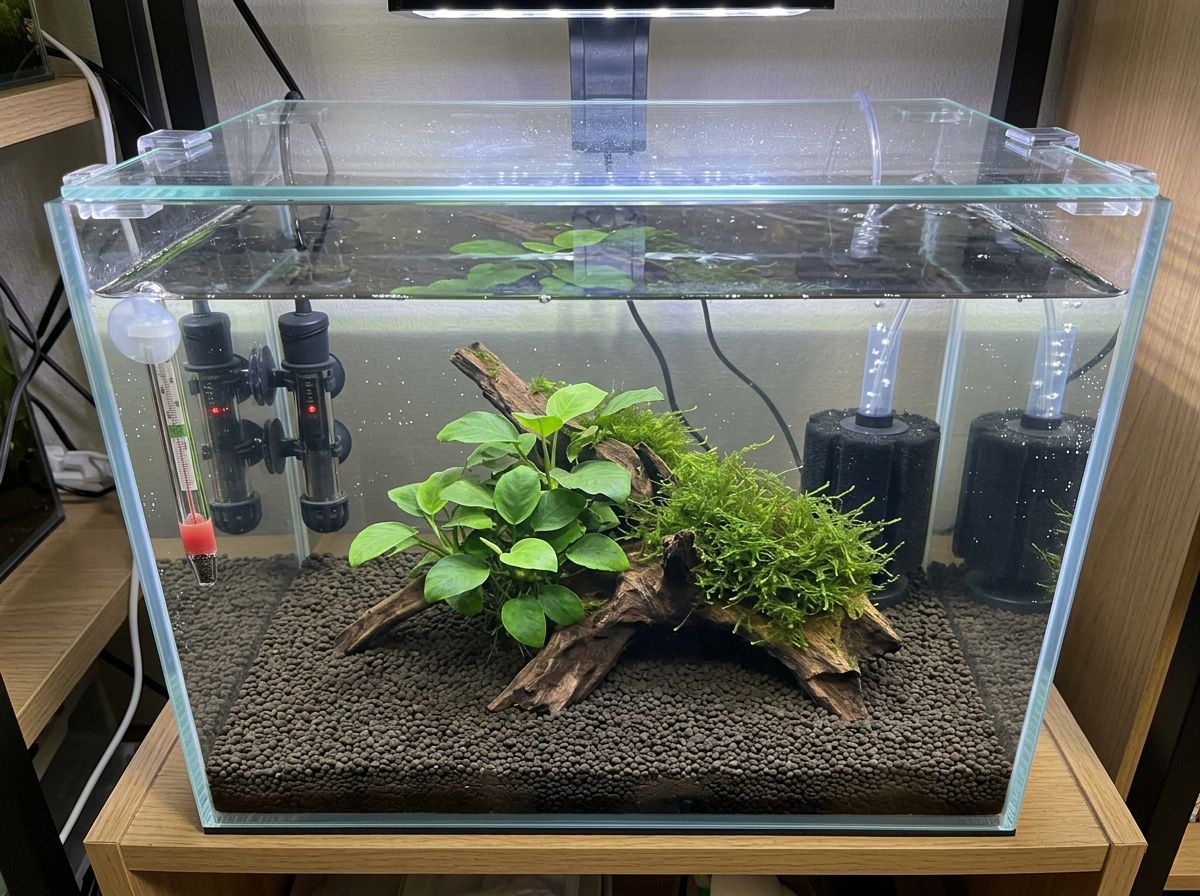
Sources range from 5 to 40 liters (Japanese shops say 5-7 liters, the standard international references 20-40 liters). For stability, this site uses at least 10 liters (2.6 gal), and ideally 20 liters (about 5 gal) or more as its baseline. A 30 cm (12 in) standard tank holding 10-12 liters, or a 30 cm cube holding 20-25 liters, is a practical beginner size.
Choose a shape with more surface area than depth. Bettas live near the surface and come up for air. Don't fill to the brim; leave an air gap above the water, and always use a lid. Bettas are surprisingly good jumpers.
Keep the flow gentle. Long-finned bettas tire in strong current. If you run a filter, use a sponge filter or something equally mild, and point the outflow at the glass.
25-28°C, with a heater as a year-round assumption
Bettas come from tropical Thailand and are comfortable at 25-28°C (77-82°F), centred around 26-27°C. That's a higher floor than the general tropical range of 22-28°C. Below 24°C (75°F) digestion suffers, and around 18°C (64°F) the risk of illness rises.
In a Japanese home, you can't hold that from autumn to spring without a heater. Use a small thermostatic heater sized to your volume, and mount a separate thermometer and check it daily. A failed thermostat can overheat or underheat the tank, and you can't tell by looking at the heater. Winter care is covered in bettas need a heater in winter.
Summer is the opposite problem: a small tank in a closed room easily passes 30°C (86°F), which is the danger zone for oxygen and ammonia toxicity. Keep it out of direct sun, use air conditioning, or move to a larger volume.
pH 6.0-7.5, and avoid sudden change
Bettas suit pH 6.0-7.5, slightly acidic to neutral. Ornamental strains adapt widely, so dechlorinated tap water is fine. Rather than chasing a number, focus on not shifting it suddenly with each water change.
Feed once or twice a day, what they finish in 2-3 minutes. They get fat easily
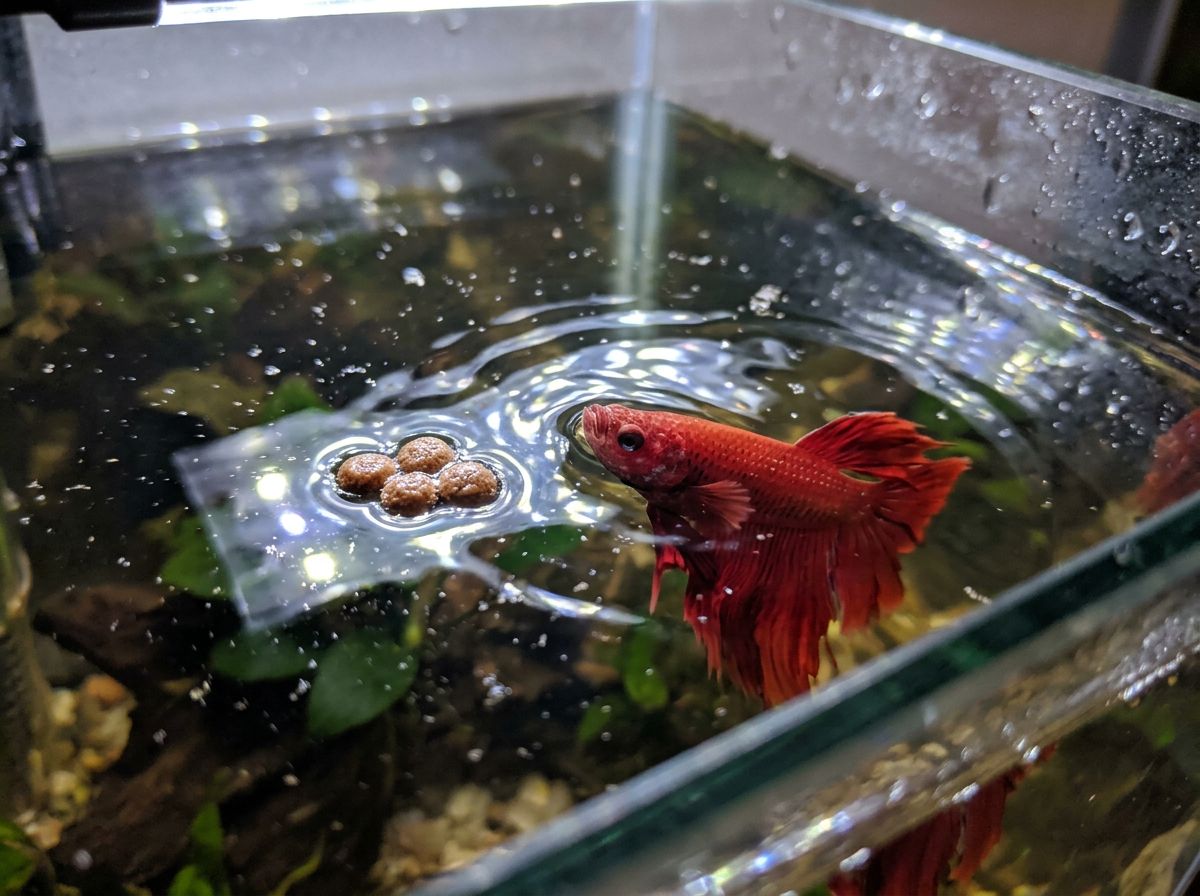
The rule is once or twice a day, as much as they finish in two to three minutes, which for betta pellets means a few (pellet size varies, so go by the count on the packet). Bettas are prone to obesity, so don't give in to begging. Leftovers foul the water. A weekly fasting day is common practice.
Weekly water changes of 1/5 to 1/3, and more often in small containers
In a filtered tank of 10 liters or more, once a week, 1/5 to 1/3 of the volume is the guide. Always dechlorinate, and match the temperature to within about 1°C (2°F) before adding it slowly. Bettas react badly to sudden temperature change, and a large change with unmatched water is a classic cause of shock.
Without a filter, in a small container, the only lever is frequency. As a guide, for 4-10 liters, roughly twice a week at 1/3 to 1/2; for a jar under 4 liters, every two to three days at half to all of the water. Especially when replacing all of it, the new water must be dechlorinated and matched to within 1°C, or the shock can kill the fish. A jar is not less work. Smaller means more work.
Bringing one home: don't skip cycling or acclimation
"Buy the tank and filter, add the betta the same day" is the most common failure. A new tank has no established bacteria, so ammonia and nitrite appear in the first weeks. The full picture is in how long does cycling take, but even a small betta tank needs daily testing until both ammonia and nitrite read zero (typically 4-6 weeks), with a small water change whenever either shows up. Nitrite peaks after ammonia, so don't stop testing early. If appetite drops or the gills move fast, test the water first.
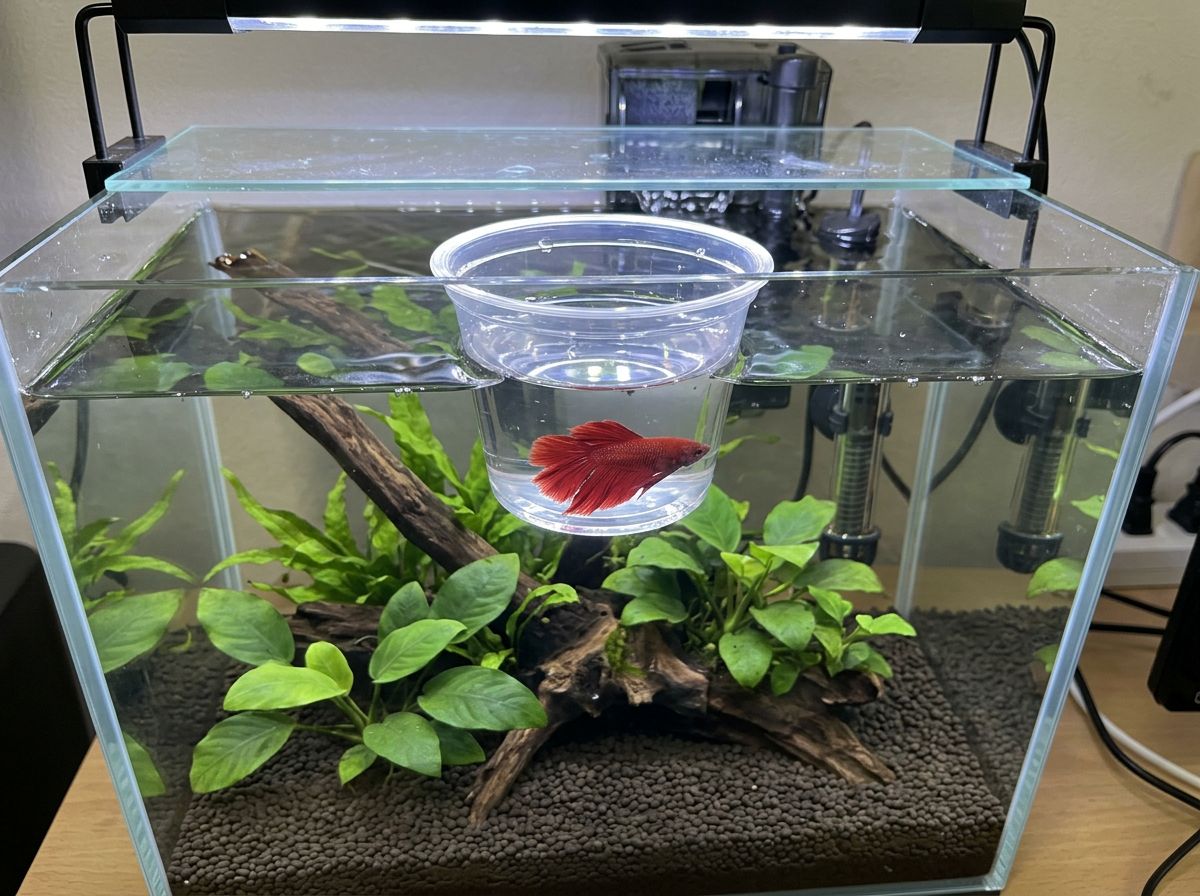
On arrival, float the cup in the tank for 15-30 minutes to match temperature, then mix tank water into the cup a little at a time before releasing. Cup-sold bettas often come from water quite different from yours, so don't skip this.
Kept alone
A male betta will fight another male until one dies. Never house two males together, and avoid layouts where males constantly see each other through a divider, which wears them down. Males and females also live apart except for breeding. Tankmates of other species work in some setups, but "alone is safest" is the conclusion. More in can bettas have tankmates?.
FAQ
How long do they live?
Around two to three years in captivity, longer with good care. Bear in mind that shop bettas are usually already six months to a year old, so you may get one to two years from purchase.
Mine looks unwell. Can I add medication or salt?
Bettas are said to have a thin slime coat and to tolerate fish medications poorly. Before adding anything on your own, check temperature and water quality. If it continues or worsens, talk to a specialist shop.
Is a filter required?
No. With disciplined water changes you can keep a betta without one, though with little surface for bacteria to colonize, you are diluting ammonia by water changes alone. A filter does make the water more stable; if you add one, keep the flow gentle.
Summary
- 10 liters minimum, 20 is better. Wide surface, not filled to the top, lid required
- 25-28°C with a thermostatic heater left in year-round, plus a separate thermometer checked daily. Watch for 30°C+ in summer
- Feed once or twice a day, 2-3 minutes' worth. They get fat
- Weekly changes of 1/5 to 1/3, matched within 1°C. Smaller containers need more
- Don't skip cycling or acclimation. Keep them alone
Small tanks swing the most. Log daily temperature and water changes in the Aquarium app and heater trouble or a slipping water-change schedule shows up early.