Guppy Care Basics: Temperature, pH and Planning for Fry
Guppies do best at a steady 23-26°C (73-79°F) and pH 7.0-8.0. Tank size, stocking, sex ratio, cycling first, and why to plan for fry before you buy.
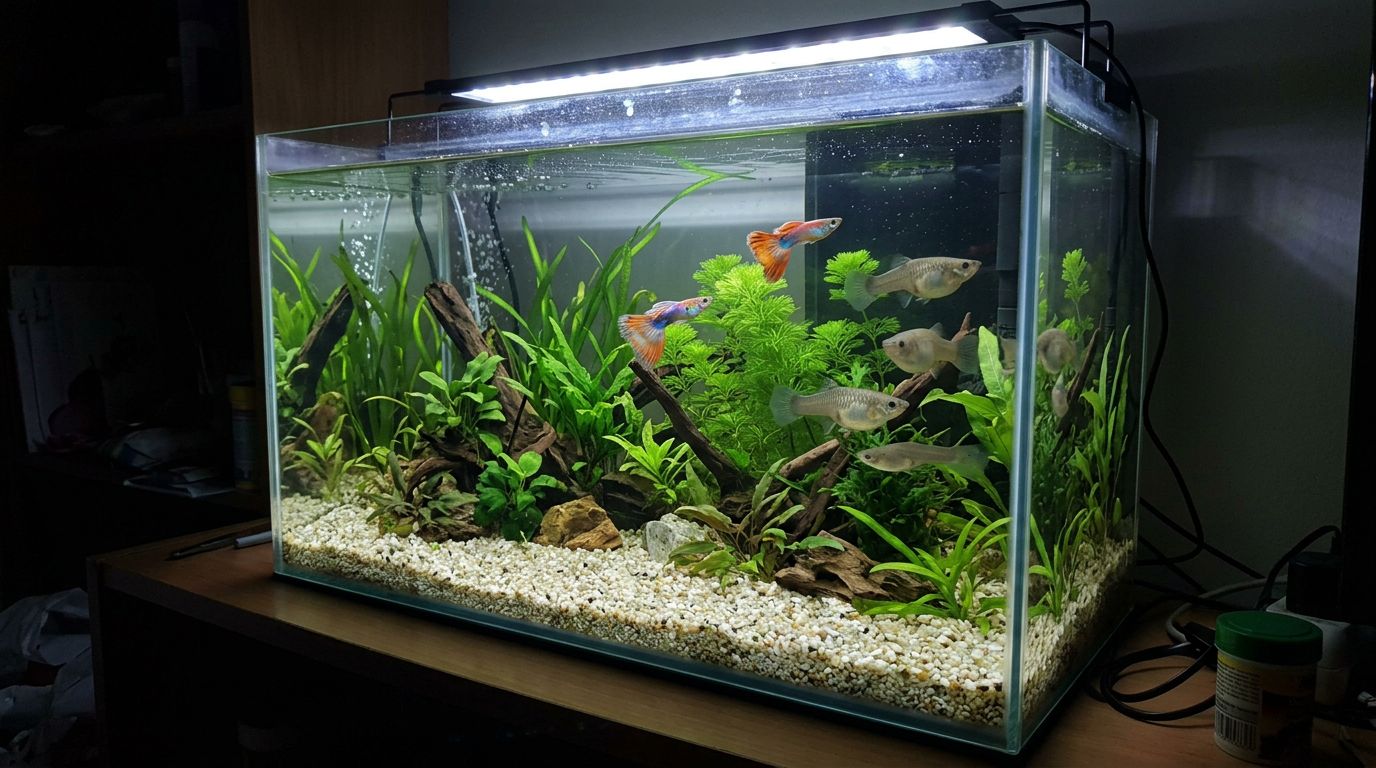
"Guppies are hardy, so they make a good first fish." Plenty of people start there and then watch their guppies go downhill within a few weeks. The short version is that guppy care rests on three things: a steady 23-26°C (73-79°F), which means a heater in winter; neutral to slightly alkaline, fairly hard water (pH 7.0-8.0); and the fact that males and females kept together will breed without any help from you. This guide covers those three, plus tank size and stocking, the new-tank period, and feeding and water changes.
Aim for 23-26°C and pH 7.0-8.0
Guppies are most active at 23-26°C (73-79°F), and the usual advice is to hold the tank steady at around 25°C (77°F). Some care sheets list 20-28°C (68-82°F), but that is the range guppies tolerate, not a target for daily running. They need a heater in winter, and above 30°C (86°F) you are in the danger zone.
For pH, aim for 7.0-8.0, neutral to slightly alkaline. That sits higher than the general tropical guideline of 6.5-7.5, and some sources give 6.5-8.5 as the range guppies can be kept in. They also prefer harder water: overseas care sheets suggest a general hardness of roughly 8°dH or more. Japanese care guides, on the other hand, give no hardness figure and simply assume tap water. Japanese tap water tends to be soft and often falls short of that figure, yet guppies are routinely kept in it, so falling short does not mean you cannot keep them. Don't raise hardness quickly just to hit the number. If you change anything, do it gradually, one thing at a time, testing as you go, and ask a specialist shop if you are unsure.
More important than the exact number is avoiding sudden change. A pH swing of 0.3 or more in a day is stressful. For substrate, anything is said to be fine as long as it does not push the water strongly acidic.
Tank size and stocking: 3-6 liters per adult, and start below that
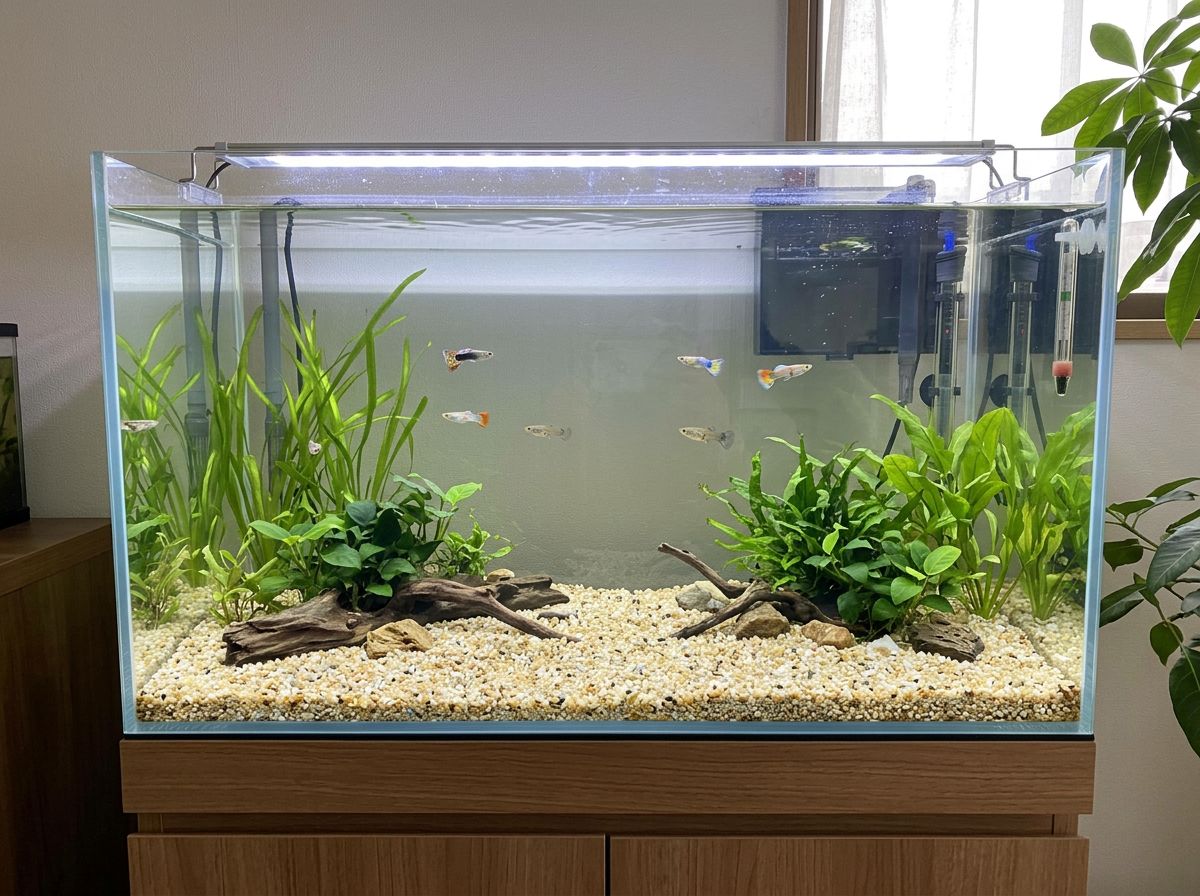
Male guppies reach about 3-4 cm (1.2-1.6 in) and females about 5-6 cm (2-2.4 in). Using the common rule of one liter of water per centimeter of fish, that works out to 3-6 liters (0.8-1.6 gal) per adult. Some manufacturer guides allow somewhat denser stocking, but guppies add to their own numbers, so it makes sense to start below this guideline.
A small group can live in a 30 cm (12 in) tank, though a 60 cm (24 in) tank is the usual recommendation for beginners. A standard 60 cm tank holds about 57 L (15 gal), which gives 9 to 19 adults on paper. A female-heavy group sits near the low end, and with fry on the way it makes sense to start below even that. Overseas sources tend to suggest 40 L (about 10 gal) or more, and every source agrees on one point: go bigger because the group will grow.
Crowding makes water foul faster. Add fish a few at a time, test nitrate for two to three weeks afterwards, and only add more once it is staying under 40 ppm.
One male to two or three females, and an exit plan
Male guppies pursue females constantly. A single female gets worn down, so keep two or three females per male and give them plants to retreat into.
Keep that mix and you will get fry. Guppies are livebearers: the female gives birth to free-swimming young rather than laying eggs, with 30 to 100 fry roughly every month (about 30 days). No special spawning site is needed.
So decide what you will do with the extra fish before you bring any home. Line up people who will take them, or plan to keep males and females apart. Releasing them into a river or pond is not an option. The guppy appears on Japan's list of alien species that may harm ecosystems (not a legal designation), published by the Ministry of the Environment and the Ministry of Agriculture, Forestry and Fisheries, with the note to take great care that they do not escape and not to release them.
Don't add them to a brand-new tank
Guppies are often chosen as the first fish for a new tank. The trouble is that a new tank has no bacteria yet to break down the ammonia that comes from waste and food. The cycle takes around four to six weeks to establish, with ammonia peaking in week one and nitrite in weeks two to three. Most deaths in this period come from ammonia or nitrite poisoning, so "guppies are just weak" is not the whole story (shipping stress or poor acclimation can also play a part).
There is a twist for guppies in particular. For the same total ammonia reading, more of it is in the toxic form at higher pH and temperature. The slightly alkaline water that suits guppies works against you during the new-tank period.
The fix is to prepare the water before the fish. Cycle the tank without fish, or seed it with filter media from an established tank. In a fishless cycle, the tank is ready when you can add an ammonia source (ammonia solution or a pinch of food) and, the next day, ammonia and nitrite both read 0 while nitrate has risen above where it started (your tap water), and that holds for several days. A tank that has only been filled and left running also reads 0 for both, so zero on its own proves nothing. The four to six weeks is a guide as well; go by the test results. Once that is confirmed, add a few fish at a time. If you do cycle with fish in the tank, keep the number small, test every day and change water often (and never dose ammonia into a tank that has fish in it). What is the nitrogen cycle? explains how this works.
When you bring guppies home, float the bag for 15 to 30 minutes to match the temperature, then mix in tank water a little at a time before letting them go. The steps are in how to acclimate new fish. If the tank already has fish, don't skip the two-week quarantine in a separate container.
Feeding and water changes
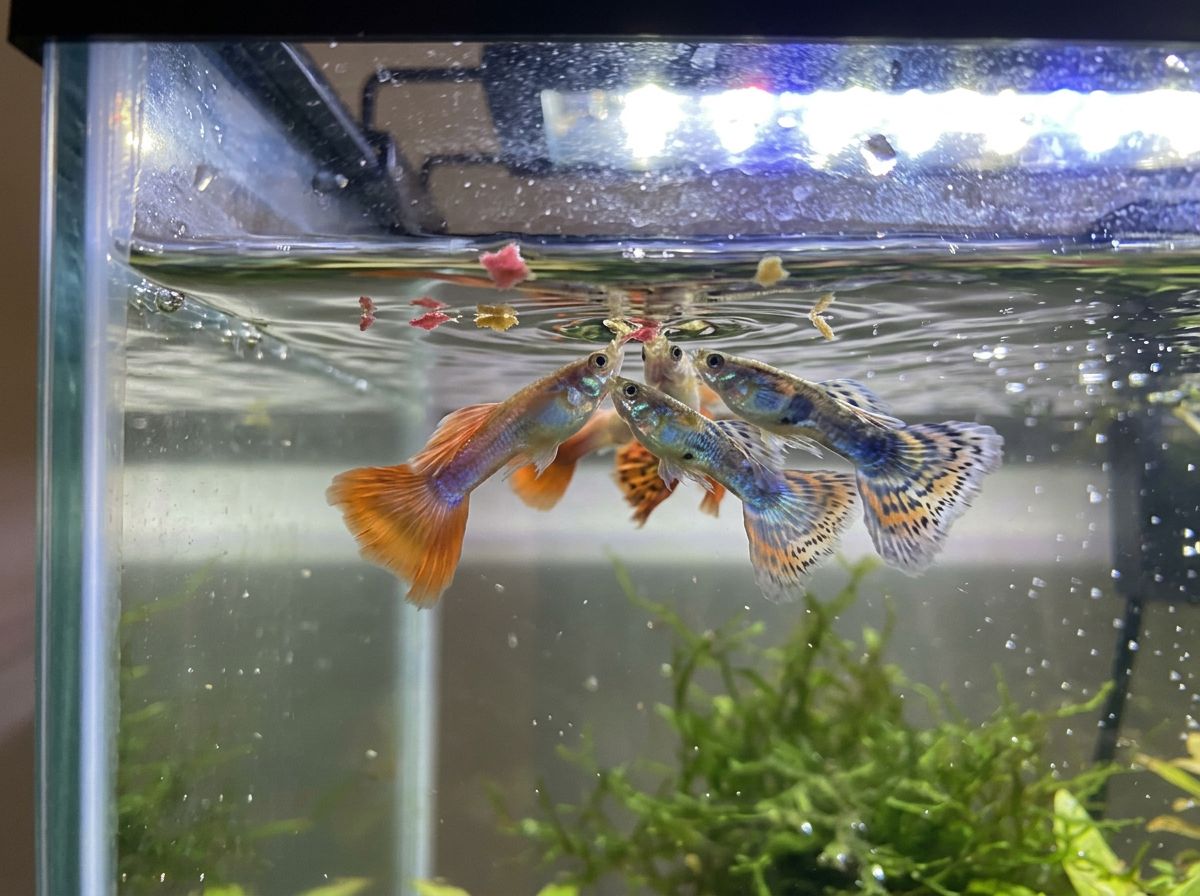
Feed once or twice a day, as much as they finish in two to three minutes. Overfeeding fouls the water and is said to shorten their lives. If the water turns cloudy within a few days, overfeeding is a likely cause (a newly set-up tank can also cloud for other reasons).
Change water once a week, a quarter to a third of the tank. Always dechlorinate the new water and match it to within 1-2°C (2-4°F) of the tank. Even when the fish look off, avoid one huge change; a third at a time over several days is safer. Wild guppies are known for tolerating polluted water, but that is no reason to change water less often. See how often and how much to change for the reasoning.
FAQ
How long do guppies live?
Around one to two years is the usual figure. Some sources say two to three years in good conditions, so the numbers vary. At least one overseas source also reports shorter lives at higher temperatures, so holding a steady 23-26°C and not overfeeding are the basics of a long life.
Can I keep guppies without a heater?
They need a heater in winter. Guppies come from northern South America and do poorly in cold water. In most of Japan, from Honshu to Kyushu, they cannot overwinter in an unheated outdoor container the way medaka do. Fit a thermometer separate from the heater and check it daily.
Japanese-bred or imported guppies?
In Japan, guppies are sold as domestic stock bred by local breeders or as imports farmed in Southeast Asia. Domestic fish are described as comparatively sturdy because they skip the long shipping and the change in water. Imported fish need extra care until they settle into local water. Either way, careful acclimation and quarantine before they join the tank matter most.
Summary
- Hold a steady 23-26°C (73-79°F); 20-28°C is only the tolerated range. Heater in winter, watch for 30°C in summer
- Aim for pH 7.0-8.0. They like harder water but are kept in ordinary tap water. Don't raise it quickly to hit a number
- Stock 3-6 L (0.8-1.6 gal) per adult as a guide, and start below it because they multiply
- One male to two or three females. Expect 30-100 fry about every month, so plan the exit first. Never release them
- Don't add them to a new tank. Wait until ammonia and nitrite read 0 the day after an ammonia source goes in and nitrate has risen, for several days running, then add a few at a time
- Feed once or twice a day for 2-3 minutes; change 1/4 to 1/3 of the water weekly
Things change quickly in a guppy tank. Log temperature and water changes in the Aquarium app and record the day fry are born as an event, and the next birth and the pace at which the water gets dirty become much easier to anticipate.