Cherry Shrimp and Neocaridina Care Basics: Temperature, pH and How Many to Start With
Neocaridina shrimp do best at 22-25°C (72-77°F), cooler than most tropical fish. Water targets, cycling first, starting numbers, feeding and water changes.
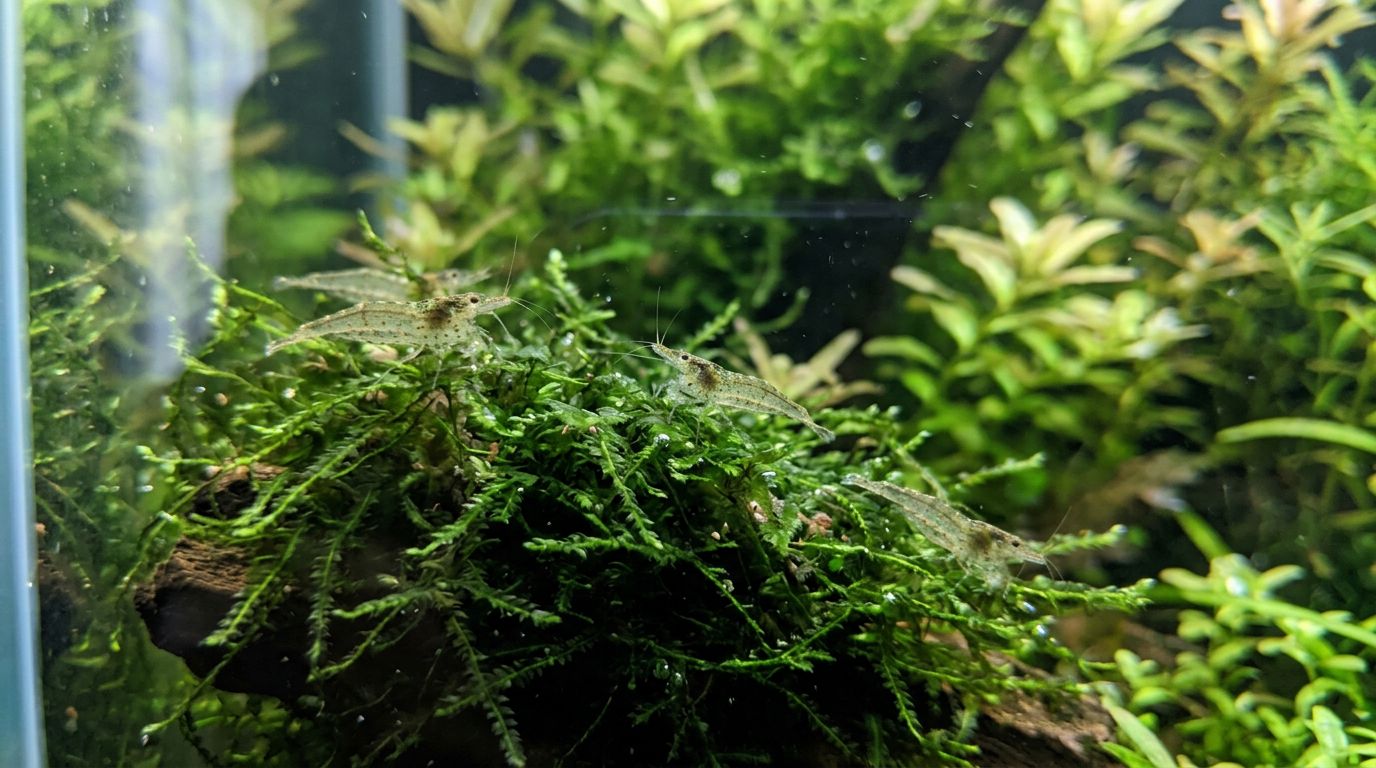
"They eat algae, they're hardy, and they breed on their own." That reputation is why so many people add Neocaridina shrimp to a tank. It is partly deserved: given the right conditions a colony will carry on for generations. But shrimp also react to changes in the water before fish do. The short version: aim for 22-25°C (72-77°F), and add them only to a fully cycled tank, after slow acclimation. This guide covers water targets, what has to be true before they go in, how many to start with, feeding, and water changes.
A note on names. In Japan the plain, translucent shrimp is sold as minami numa ebi; red cherry shrimp and the other color forms are closely related species and selectively bred varieties in the same genus, Neocaridina. Care is practically the same, so everything here applies to both. Two things to remember: shrimp sold under one name are not always the lineage the label suggests, and close relatives interbreed.
Aim for 22-25°C: a lower ceiling than tropical fish
Here are the targets.
| Parameter | Target | Notes |
|---|---|---|
| Temperature | 22-25°C (72-77°F) | The range they can be kept in is roughly 16-28°C (61-82°F) |
| pH | 6.5-7.5 | Stability matters more. Avoid swings of 0.3 or more in a day |
| GH (general hardness) | 6-10 dGH | Too low tends to cause molting trouble |
| KH (carbonate hardness) | 3-6 dKH | Low KH lets pH drop suddenly |
| Ammonia and nitrite | 0 mg/L | Any reading needs action |
| Nitrate | under 20 mg/L | A shrimp-specific figure from one source; the general guideline is 25 or less. If it keeps climbing, revisit your water-change routine |
The general tropical range is 22-28°C (72-82°F), but for these shrimp the upper end sits lower. The 16-28°C span is what they can be kept in, not what you aim for day to day. Start cooling measures once the tank passes 28°C (82°F) in summer; a run of days above 30°C (86°F) is reported to wear them down. They cope better with the cold side, and the plain Japanese form has a track record of overwintering outdoors as long as the water does not freeze.
Sources differ on pH, but if your tap water falls in the range, keeping it steady beats trying to move the number. GH and KH are tied to molting, and the GH floor is higher than the usual community-tank guideline. If you measure TDS, 150-250 ppm is the commonly cited range, but treat it as a secondary reading. GH and KH come first.
These GH, KH and TDS targets come from overseas sources. Tap water in Japan, and in other soft-water areas, often tests below them. Shrimp are kept successfully in water under these targets, so don't raise hardness in a hurry just to hit the numbers. If you do change it, go a little at a time, one thing at a time, testing as you go, and ask a specialist shop when unsure.
Add them only after the tank has cycled
Shrimp are very sensitive to ammonia and nitrite; even a small spike is said to be able to hit a whole colony. So the rule is to add them to a tank that has finished cycling.
Judge that by test results, not by the calendar. Run the tank with an ammonia source (ammonia solution or a small amount of food); it is cycled when, the day after a dose, ammonia and nitrite both read 0 and nitrate is higher than it was at the start (your tap water), and that holds for several days. A 0 and 0 reading in a tank that has only had water running through it proves nothing. Four to six weeks is a typical timeframe, and it varies with conditions. Time passing is not, by itself, the green light. The mechanism is explained in the nitrogen cycle basics.
Putting shrimp into a tank that is still cycling "to see how it goes" is not something we recommend. They show the damage before fish would.
How many, and what size tank: about ten, with water to spare
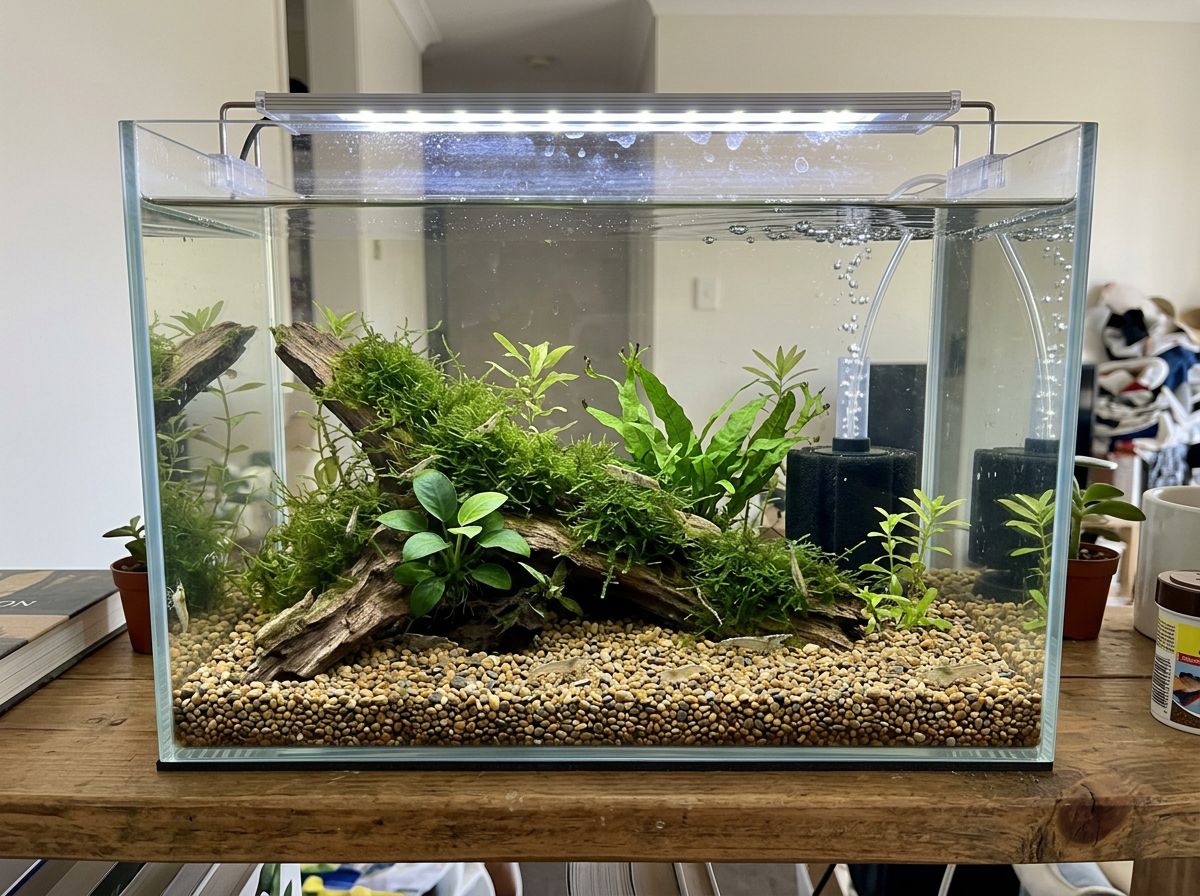
You can keep just a few, but if you want them to breed, starting with around ten makes it likely you have both males and females. Adults are 2-3 cm (about 1 in), with females the larger sex, and they live roughly one to two years, so it makes sense to think of the colony as something that renews itself.
A 30-45 cm (12-18 in) tank is an easy size to manage. People do keep them in very small containers, but the less water there is, the faster temperature and water quality shift, and that works against an animal that dislikes sudden change. For a first shrimp tank, give yourself the extra volume. They multiply readily when conditions suit them, so don't crowd the tank at the start either.
Feeding depends on the tank
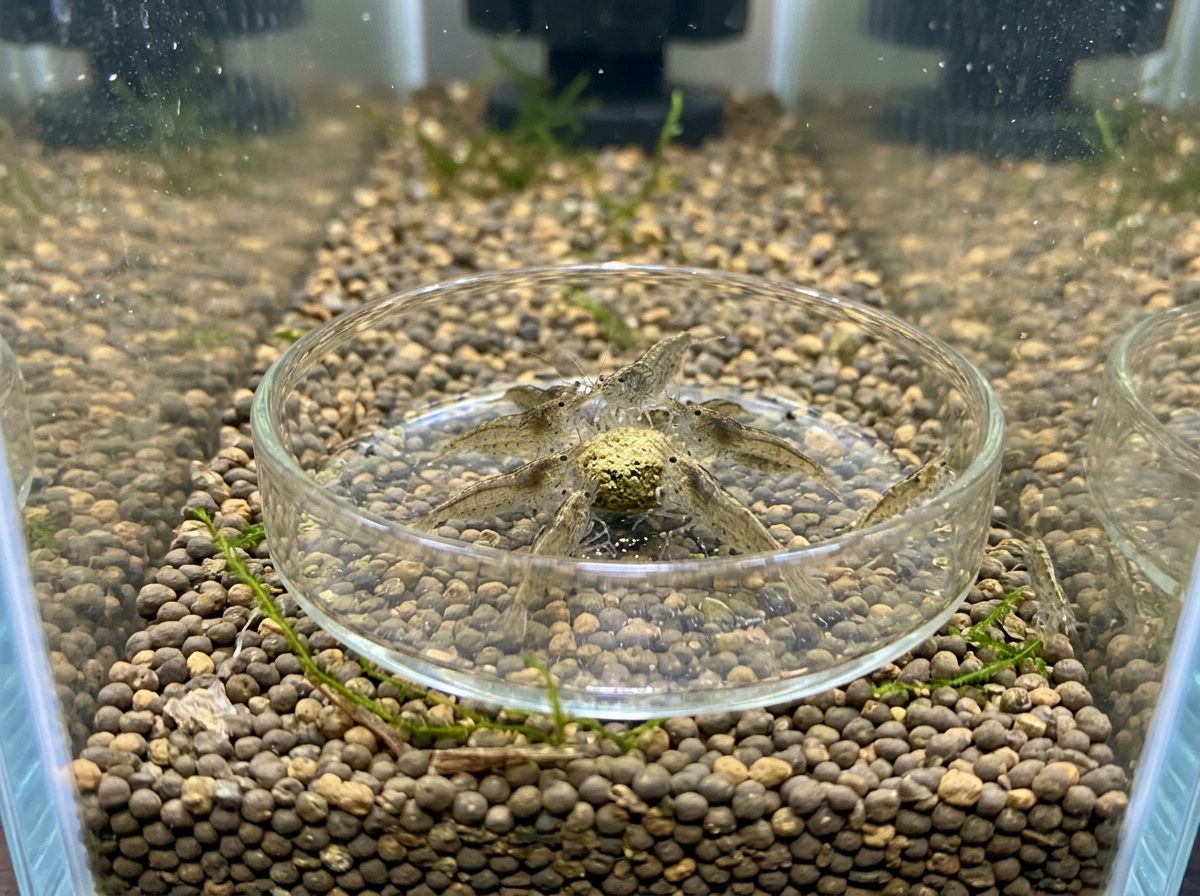
Don't copy the "once or twice a day" rule for tropical fish. Decide by the state of the tank.
- (a) Tanks with plenty of algae and biofilm (the slimy microbial film on surfaces): outdoor tubs, or tanks that have run for several months and have visible algae. Here a very small supplementary feed about once a week is said to be enough
- (b) Everything else: newly set-up tanks, heavily stocked tanks, and tanks shared with fish. Make a shrimp-specific food the staple. Start from every other day, give what they can finish, and adjust so that nothing is left over
When in doubt, go with (b). Whether there is "plenty" of algae is hard for a beginner to judge, and specialist shops point out that shrimp starve more often than people expect. At the same time, leftovers turn into ammonia. Offer a little, and cut back if any remains. If you feed vegetables, use pesticide-free produce only.
Water changes and acclimation: slowly
The most common causes of shrimp deaths are reported to be sudden shifts in pH or temperature, not disease.
When you bring them home, float the bag for 15-30 minutes to match temperature, then drip-acclimate for 30-60 minutes.
For water changes, keep this order:
- Always treat new water with a conditioner to remove chlorine and chloramine
- Match it to within 1-2°C (2-4°F) of the tank
- Add a small amount, slowly
Never skip the conditioner. Chloramine does not gas off when water is left to stand; see chloramine and dechlorinators. For volume, treat the general guideline (weekly, 1/4 to 1/3) as the ceiling and stay toward the small side, on a regular schedule.
FAQ
How are they different from Amano shrimp?
Size and breeding. Amano shrimp are bigger, with males around 4 cm (1.6 in) and females around 6 cm (2.4 in), and each one tends to clear more algae. But Amano shrimp cannot breed in fresh water. Neocaridina do breed in the tank, so they make up for it in numbers. Amano shrimp are also reported to prey on them in some cases.
Do they need a heater?
The plain Japanese form has overwintered outdoors. Cherry shrimp are said to tolerate water down to about 17°C (63°F), so in a room that does not fall far below that they can go unheated. An unheated room can get colder than that in winter, though. In a cold room, a heater holding the low 20s°C (low 70s°F) keeps things stable.
Can I keep different colors together?
Care is identical regardless of color, but Neocaridina varieties interbreed. If you want to keep a color line, give each variety its own tank.
Summary
- Aim for 22-25°C (72-77°F). The ceiling is lower than for tropical fish; start cooling above 28°C (82°F)
- pH 6.5-7.5, GH 6-10 dGH, KH 3-6 dKH. Stability over exact numbers; don't rush hardness upward if yours is below target
- Add shrimp only after cycling: ammonia 0 and nitrite 0 the day after dosing an ammonia source, with nitrate rising, confirmed by testing
- About ten to start a breeding group, in a 30-45 cm (12-18 in) tank. Avoid very small containers
- Feed according to the tank. When unsure, shrimp food every other day, with nothing left over
- Water changes: dechlorinate, match temperature, add a little slowly. Drip-acclimate new shrimp for 30-60 minutes
Trouble with shrimp often shows up first as a change in temperature, GH or KH. Log temperature and water tests in the Aquarium app and you will catch a summer climb or a drift in hardness early. The app's green, yellow and red ratings use general freshwater ranges (22-28°C / 72-82°F counts as fine for temperature), so read your log against the shrimp targets: 22-25°C (72-77°F), GH 6-10 dGH, KH 3-6 dKH.