How to Calculate Aquarium Volume (It's Less Than You Think)
Tank volume is length x width x height / 1000, but a standard 60 cm tank really holds about 57 liters, not 65. Learn why and how to find your real volume.
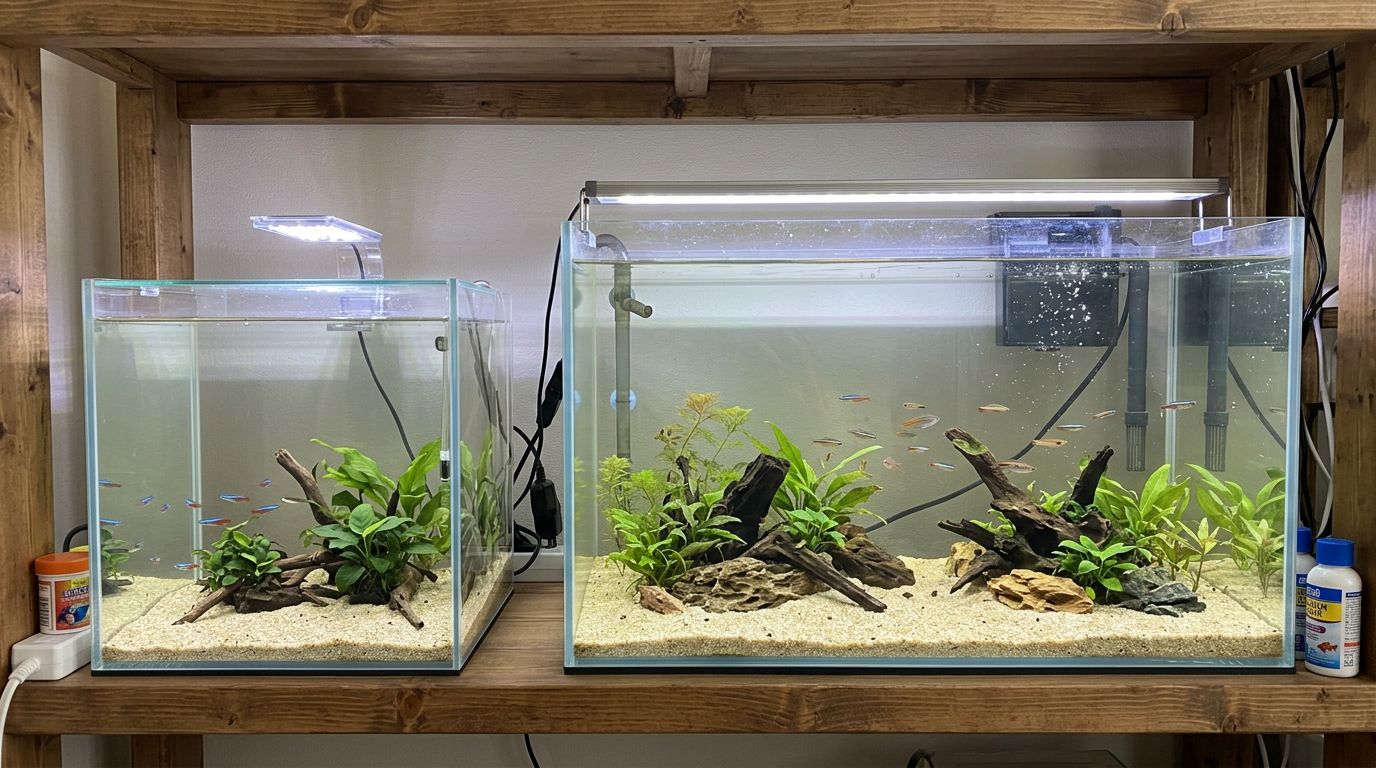
"The conditioner says one capful per X liters. So how many liters is my tank?" Surprisingly few people can answer that off the top of their head. The short version: volume is internal length x width x height in cm, divided by 1000, and a standard 60 cm tank actually holds about 57 liters (roughly 15 US gallons). Here's how to do the math, why the real number is lower than the catalog says, and everything you'll use the figure for.
The basic formula: L x W x H / 1000
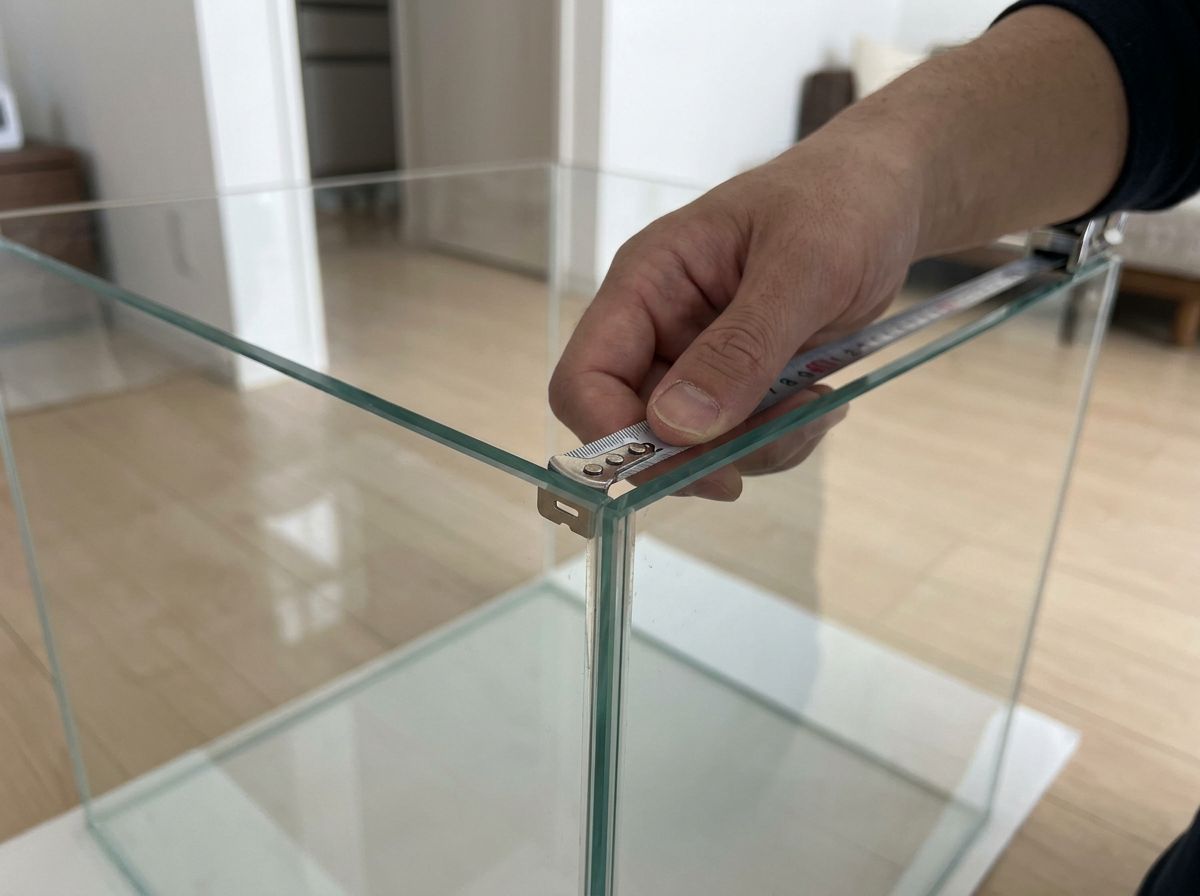
A tank is a box, so the math is simple:
Volume (liters) = depth (cm) x width (cm) x height (cm) / 1000
Since 1,000 cm³ is one liter, you multiply the three sides in centimeters and divide by 1000. For example:
- 30 cm cube (30 x 30 x 30 cm): 27,000 / 1000 = 27 L
- Standard 60 cm tank (60 x 30 x 36 cm): 64,800 / 1000 = 64.8 L
That's the theoretical capacity when filled to the brim, and it's roughly what the catalog lists. The water actually in your tank is less.
Why real volume is lower than the catalog
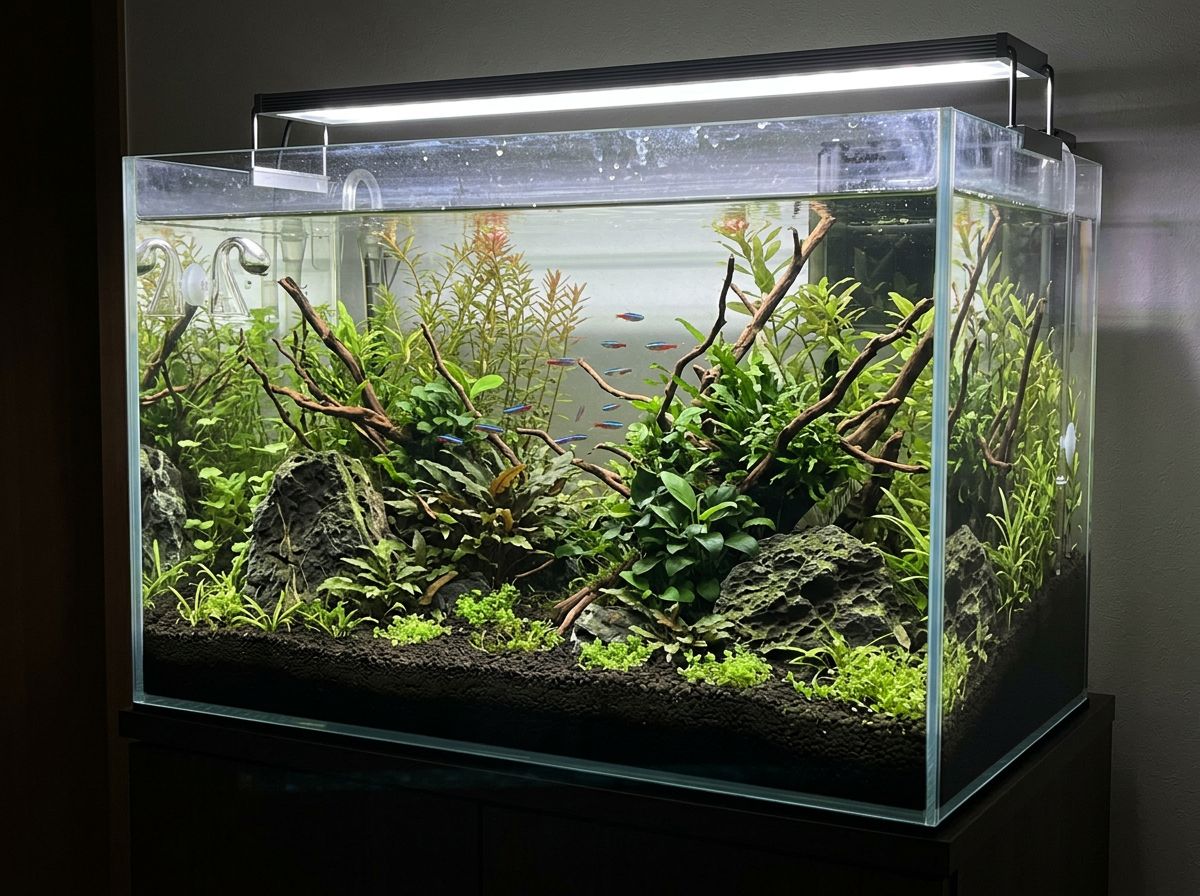
A standard 60 cm tank calculates to about 65 L, but the real water volume is about 57 L. Three things account for the gap:
- Glass thickness. People tend to measure the outside, but water only fills the inside
- Water level. Nobody fills to the rim; you run a few centimeters below it
- Substrate and hardscape. Soil, gravel, rocks, and driftwood displace water. A heavily planted tank with deep substrate loses the most
So the same 60 cm tank holds different amounts as a bare-bottom setup versus a planted tank with thick soil. "About 57 L" is a typical figure; ideally work out your own tank's real volume once.
Finding your tank's real volume
- By calculation: use internal depth x width x actual water height, then roughly subtract the substrate (footprint area x substrate depth)
- By measurement: during setup or a large water change, count how much you pour in using a container of known size. This is the most accurate method
What you'll use the number for
Volume is the basis for nearly every "how much" in the hobby.
Dosing conditioner and additives
Dechlorinator, water treatments, and liquid plant fertilizer are all dosed per liter. Overestimate the volume and you overdose; underestimate and you underdose. Since new water must be at 0 ppm chlorine, you want the conditioner dose to be right.
Heater wattage
Heaters are rated for a volume range, and the package lists the tank size they suit. Pick one that matches your real volume. Too small and it can't reach the set temperature in winter; too large and a malfunction carries more risk.
Stocking
A common Japanese rule of thumb is 1 cm of fish per liter of water (similar in spirit to the "inch per gallon" guideline). For a standard 60 cm tank at about 57 L, that works out to around 15-20 small tetras. Treat it as a starting point only. The practical method is to add fish gradually, test nitrate weekly for 2-3 weeks after each addition, and only add more once it stays under 40 ppm.
Water change amounts
The "10-30% once a week" guideline becomes concrete once you know the volume: 20% of 57 L is about 11 L, or a bit more than one bucket.
A note on standard sizes
In Japan, "standard" tanks are named by their width (30 cm, 45 cm, 60 cm, 90 cm, and so on), but there are wide, tall, and low variants with the same width and different depth or height. Write down all three internal dimensions when you buy a tank.
Once you've worked out the volume for each tank, keep it somewhere you'll find it. If you track it in the app, Aquarium shows a volume for each tank from the dimensions you enter, so the figure is at hand whenever you work out a water change.
FAQ
For a 60 cm tank, should I use 57 L or 65 L?
For dosing conditioner and medication, and for stocking guidelines, use the real volume (about 57 L, or better, your own measured figure). The 65 L number is the brim-full theoretical capacity and isn't used for day-to-day care.
How much should I subtract for substrate?
Estimate it as footprint area x substrate depth. In a 60 cm tank with a deep layer, that can be several liters, so planted tanks benefit most from actually measuring. If you need precision, count what you pour in at your next big water change.
Internal or external dimensions?
Internal. Only the inside holds water. If you only know the external dimensions, remember that the real figure is smaller by the thickness of the glass.
Summary
- Volume = depth x width x height (cm) / 1000
- A standard 60 cm tank calculates to about 65 L, but glass, water level, and substrate bring real volume to about 57 L
- Real volume is the basis for dosing, heater wattage, stocking (1 cm per liter), and water change amounts
- Record each tank's volume once and reuse it
You only need to work this out once, and you'll rely on it constantly after that. Register your tank in the app so the volume is always there to check.