Neon Tetra Care Basics: Temperature, School Size and the First Two Weeks
Neon tetras do best at 22-26°C (72-79°F) and a steady pH of 6.0-7.5. School size, stocking a 60 cm tank, cycling checks, acclimation and quarantine.
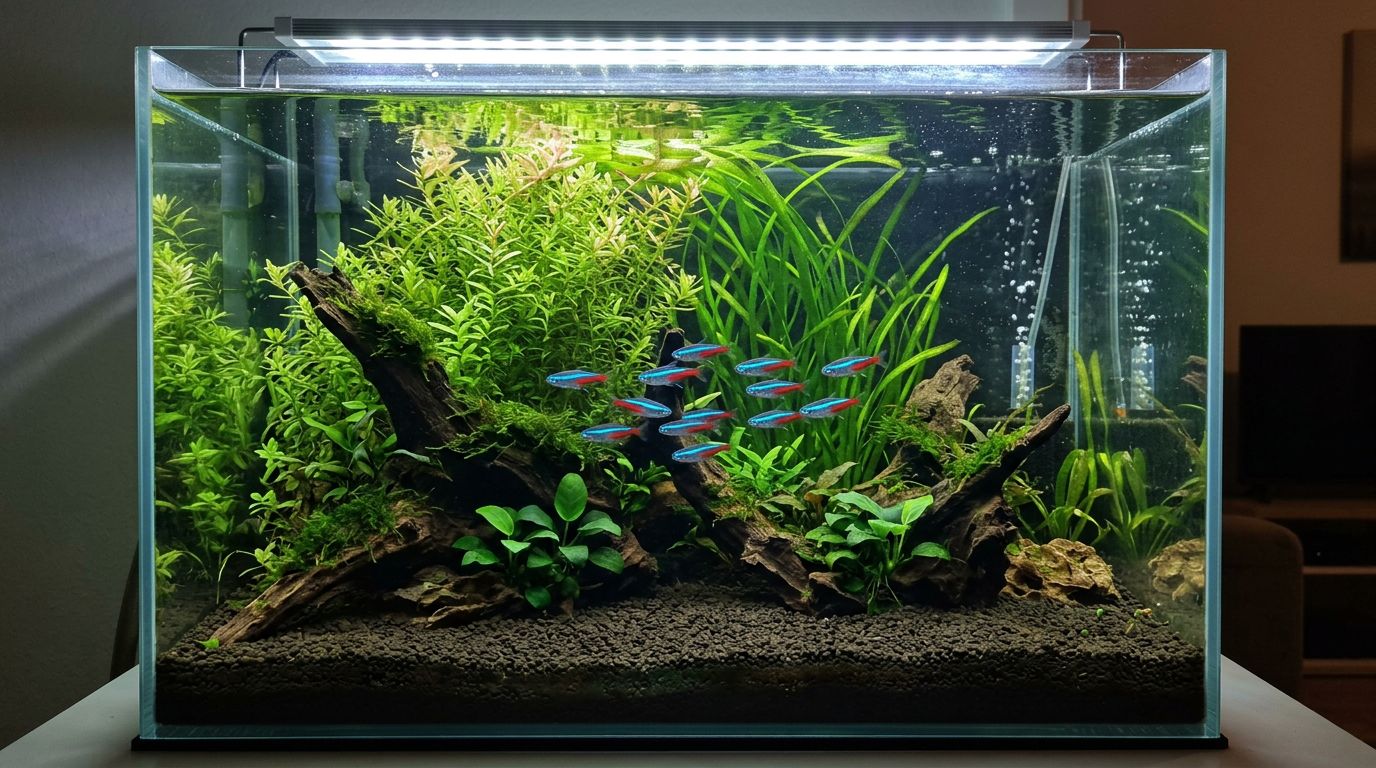
"They told me neon tetras were a hardy beginner fish, and I still lost half of them in two weeks." It is the most common neon tetra story there is. The short answer: neons are easy to keep in an established tank, but they are vulnerable to a tank that is still cycling and to skipped acclimation. Nearly all the trouble happens in the first two weeks. This guide covers target temperature and pH, school size and tank size, and a step-by-step plan for those first two weeks.
Target 22-26°C, and a stable pH of 6.0-7.5
The target temperature for neon tetras is 22-26°C (72-79°F), with most references centering on 24-25°C (75-77°F). Compared with the general tropical range of 22-28°C (72-82°F), the upper limit is lower. Some Japanese sources extend the range to 28°C, but international specialist sites put the ceiling at 25-26°C, so this guide treats 26°C as the upper target.
You will also see 20-28°C (68-82°F) quoted. That is the span you get by stitching different sources together, a range the fish can tolerate, not a day-to-day target. A heater is essential in winter: below 20°C (68°F) appetite drops, and without a heater the fish can weaken.
For pH, aim for 6.0-7.5 (slightly acidic to neutral). What matters more than the number is stability. There is no need to force the pH down with pH-lowering products; avoiding swings of 0.3 or more in a day comes first.
At least 5-6 fish, ideally 8-10, in a 60 cm tank
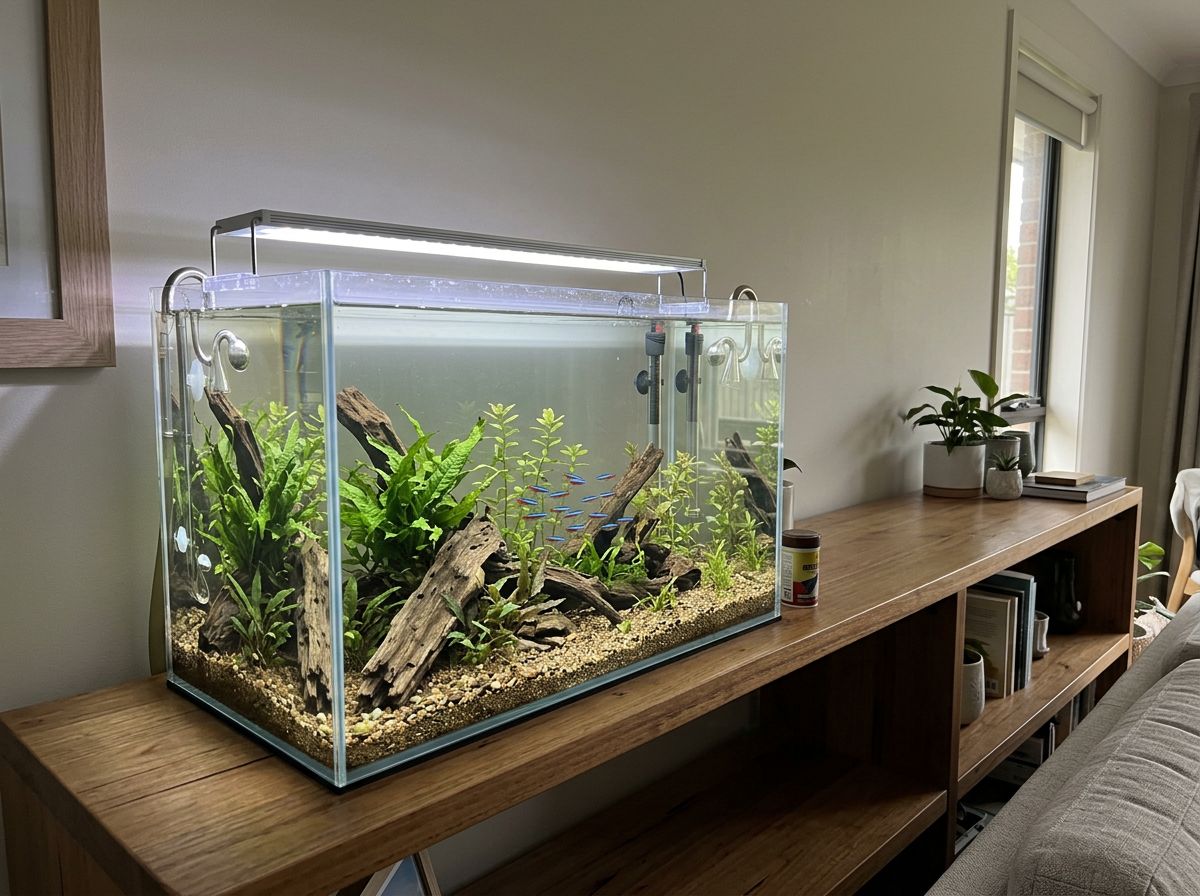
Neon tetras are schooling fish. In small numbers they turn timid and spend their time hiding, so keep at least 5-6, and ideally 8-10. They are not a fish to keep singly.
A standard 60 cm (24 in) tank of about 57 L (15 gal) is the baseline for a proper school. You can start in a 30 cm (12 in) tank, but the minimum school of 5-6 is already about the limit there, with no room for more fish or tank mates. The smaller the tank, the faster it heats up in summer and the faster water quality slips. If you want to watch a real school and keep the water steady, 60 cm makes life easier. Not sure how much water your tank holds? See how to calculate tank volume.
How many in a 60 cm tank? Start with 6-10
A widely used stocking guideline is one liter of water per centimeter of fish. For neons at 3-4 cm (1.2-1.6 in), that puts a standard 60 cm tank at around 15-20 fish in the end.
The key point is that 15-20 is a ceiling, not the number to start with. Add a lot of fish at once and the filter bacteria cannot keep up, so ammonia and nitrite can climb again.
- Start with 6-10, enough to form a school
- After adding fish, test nitrate every week for 2-3 weeks
- If it stays under 40 mg/L, add the next group
Shops and manufacturers often quote "one fish per liter." That is a much denser figure than the guideline above, so in a first tank it is safer to start low and build up while watching nitrate.
The first two weeks: confirm the cycle, acclimate, observe daily
1. Judge the cycle by test results, not by the calendar
Setting up a tank and adding fish the same day is the classic mistake. Before the filter bacteria are established, ammonia and nitrite build up, and small-bodied neons are the first to feel it.
After setting up the tank, add an ammonia source (ammonia solution made for fishless cycling, or a small amount of fish food) and run the filter. This is a step for a tank with no fish in it yet (if fish are already in the tank, do not add ammonia solution or extra food; the fish themselves are the ammonia source). The tank is ready for fish only when all three of these are true:
- Ammonia reads 0 the day after you dose it
- Nitrite also reads 0
- Nitrate is higher than it was at the start (your tap water reading)
Confirm the same result several days in a row, not just once, before you bring fish home. If you are using fish food as the source, the next-day check is hard to read; instead confirm that ammonia and nitrite stay at 0 for several days while you keep adding small amounts of food, and that nitrate keeps rising.
"I ran it empty for a few weeks" is not a test. With no ammonia source, running water alone does not grow the bacteria, and that water will read 0 ammonia and 0 nitrite no matter what. Test your tap water for nitrate on day one and write it down so you have something to compare against. With an ammonia source, expect roughly four to six weeks; seeded filter media can shorten it. For how the cycle progresses week by week, see the nitrogen cycle, and for the steps see how to do a fishless cycle (use the three checks in this article to decide when it is complete).
Once the tank passes, keep adding a small amount of the ammonia source until the fish are due, so the bacteria keep their capacity. Stop the day before the fish arrive, do a water change to bring the accumulated nitrate down to 25 mg/L or less (under 40 mg/L at the very least), and confirm ammonia 0 and nitrite 0.
2. Acclimate for 30 minutes plus 30-60 minutes
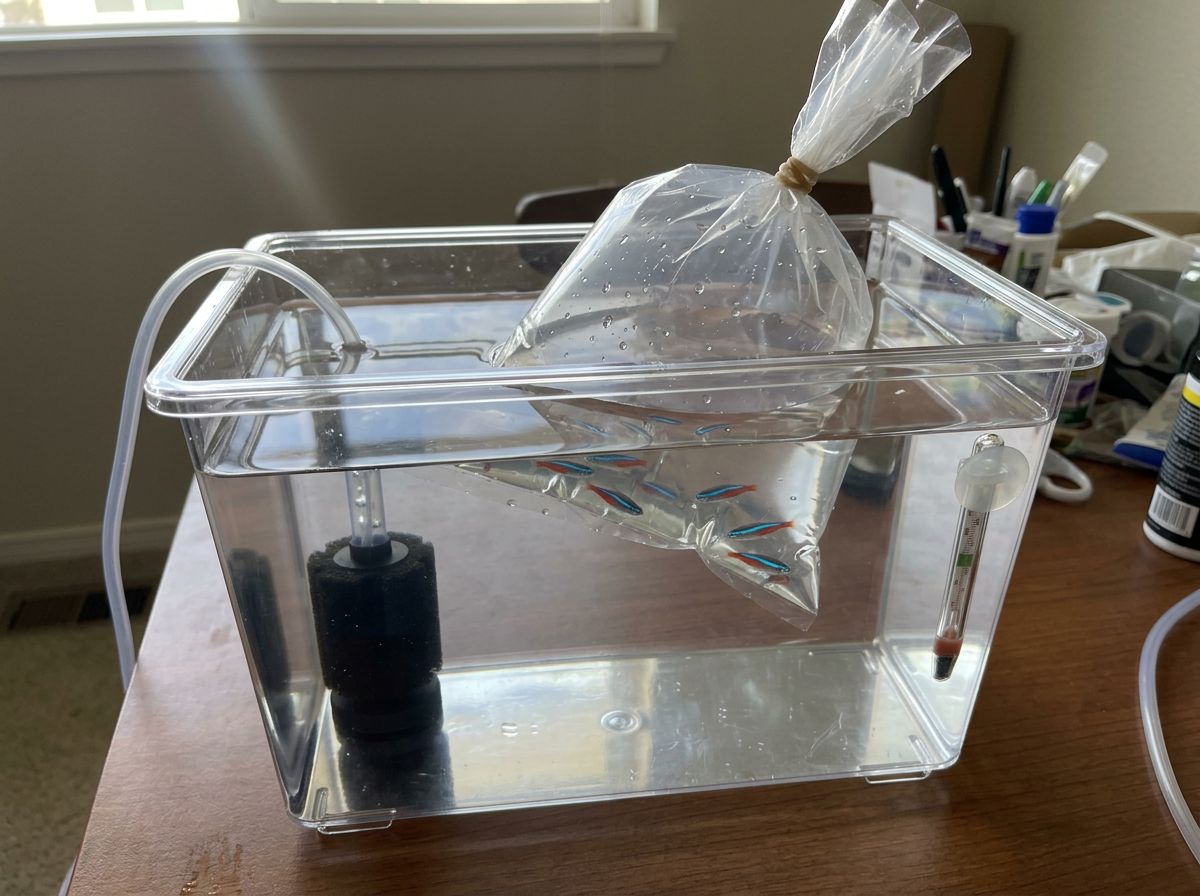
Acclimate the fish to the water they are going into. For the very first fish in a main tank that holds no fish yet, that is the main tank; when adding to a tank that already has fish, it is a separate quarantine container (next step). Float the sealed bag for 30 minutes to match temperature, then add small amounts of the destination water to the bag over 30-60 minutes to adjust them to it. Finally, net the fish across and leave the bag water out.
Drip acclimation is not mandatory, but it is the safer choice when the shop's pH is very different from yours or the fish look weak.
3. Observe your first fish in the main tank; quarantine later additions
When the cycled main tank has no fish in it at all yet, there is nothing for a disease to spread to, so the main tank itself serves as the quarantine. Skip the separate container and observe the fish daily for two weeks in the main tank. Add no other fish during that time. Do not add salt or medication; if something looks wrong, ask a specialist shop.
When adding to a tank that already has fish, keep the new arrivals in a container apart from the main tank and simply observe them for two weeks (quarantine). The point is to avoid carrying disease into the main tank, and longer is safer. Leave at least two weeks after the previous introduction before bringing more fish home, and always pass them through this quarantine container. No salt or medication here either.
Do not use a small, unfiltered, unheated tub as a quarantine container.
- Run an air stone and something like a sponge filter seeded with media from the main tank (do not return that media to the main tank afterward)
- With no filter available, do partial water changes daily or every other day with temperature-matched water
- Always fit a heater and thermometer, set to the same temperature as the main tank
When the two weeks are up, match the temperature once more before moving the fish.
If you do end up quarantining in a separate container while a fishless main tank keeps running, do not leave the main tank idle. Without an ammonia source the bacteria lose capacity. Keep adding a small ammonia source such as a little fish food, stop the day before the move, and confirm ammonia 0 and nitrite 0 before moving the fish.
Feeding and water changes
Feed once or twice a day, only what they finish in two to three minutes. Their mouths are small, so small, slow-sinking granules suit them. Neons are said to put on weight easily, and overfeeding leads to obesity and poorer water quality. If you split feeding into more sessions, do not increase the daily total, and remove leftovers.
Change water once a week, a quarter to a third of the tank. Always dechlorinate the new water and match it to within 1-2°C (2-4°F) of the tank before adding it.
FAQ
Do neon tetras need a heater?
In winter, yes. Below 20°C (68°F) appetite drops, and without a heater the fish can weaken. You cannot spot a failing heater by looking at it, so fit a separate thermometer and check it every day.
How long do neon tetras live?
Around two to five years in an aquarium. Losing them after a year or two is a common story, but do not write that off as old age. Look first at how they were introduced and at the water quality.
Can I breed them at home?
It is considered difficult at home. Breeding calls for very soft, acidic water, a darkened dedicated tank and separating the parents. Keeping a school healthy for the long term is a better first goal.
Summary
- Target 22-26°C (72-79°F), a lower ceiling than tropical fish in general. Keep pH steady within 6.0-7.5
- School of at least 5-6, ideally 8-10. A standard 60 cm tank is the baseline
- Around 15-20 in a 60 cm tank in the end. Start with 6-10 and test nitrate weekly (under 40 mg/L) for 2-3 weeks after each addition
- The cycle is done when ammonia and nitrite read 0 the day after dosing ammonia and nitrate has risen above the starting value, several days in a row (a check for a tank with no fish in it yet)
- Acclimate for 30 minutes plus 30-60 minutes. Observe your first fish daily for two weeks in the main tank; quarantine later additions for two weeks in a separate container (observation only)
- Feed once or twice a day for 2-3 minutes; change 1/4 to 1/3 of the water weekly
For the first two to three weeks after adding fish, testing ammonia and nitrite daily lets you catch changes early. Log your readings in the Aquarium app and you can look back at the trend alongside the dates you added fish. Note that the app judges temperature against the general tropical range (22-28°C), so read your log against the neon tetra target of 22-26°C (72-79°F).